
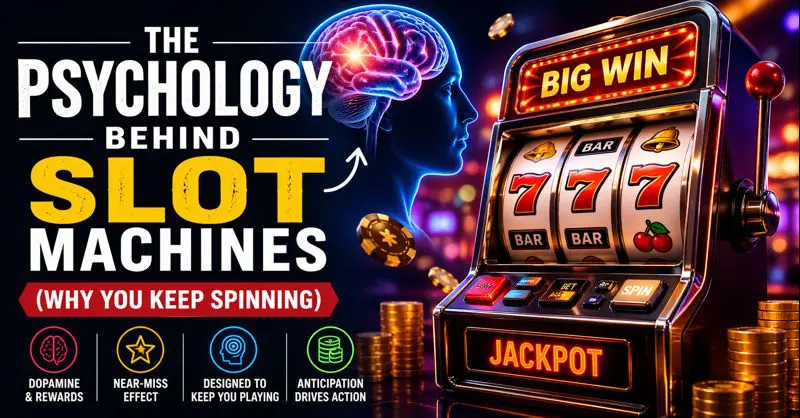
Walk through any casino and you can spot the slot section before you see it. The sound reaches you first: chirps, bells, synthetic coins, tiny victory songs stitched together into a wall of noise that feels weirdly cheerful at two in the morning. Then come the lights, the bright stools, the players leaning forward with a look that is part hope, part trance. From the outside, it can seem ridiculous. Why keep pressing a button for a game that mostly takes your money? Sit down for twenty minutes, though, and the answer starts to feel less abstract. Slot machine psychology is not built on one trick. It is built on a stack of them, all tuned to the way attention, reward, and habit work in the brain.
The part most people miss is that slot machines are not really selling winning. They are selling anticipation. That little pause before the reels stop matters almost more than the result itself. Your brain lights up in expectation, not just in celebration. Dopamine gets talked about like it is a simple “pleasure chemical,” but that is too neat. In practice, it is heavily tied to motivation and reward anticipation. The moment before the reveal can be more stimulating than the payout, especially when the outcome feels close. That is one reason why slot machine reward system design leans so hard on suspense. A near hit can pull harder than a small win.
This is where variable rewards system design does its real work. If a machine paid on a fixed schedule, people would get bored fast. Instead, rewards arrive unpredictably. Behavioral psychologists call this intermittent reinforcement, and it is one of the strongest ways to shape repeated behavior. You do not know whether the next spin will pay, which makes the next spin feel oddly important. I have seen players who would never describe themselves as impulsive fall straight into this pattern. They are not chasing one jackpot so much as chasing the possibility that the next press will be the one. That uncertainty reward mechanism is sticky.
The near miss effect deserves its own spotlight because it is so misunderstood. When two jackpot symbols line up and the third lands just above or below the payline, your rational brain knows you lost. Emotionally, it feels like you almost won. In most areas of life, almost succeeding can be motivating in a healthy way. In gambling, it can distort judgment. The brain often treats the near miss as meaningful feedback, even when the outcome was generated by a random number generator long before the reels stopped spinning on screen. That gap between what the machine is actually doing and what the player feels is one of the core engines of gambling addiction slots.
Casino designers also understand that a slot machine is not just a game. It is an environment. Lights, sound effects, vibration, and pacing all support the compulsion loop gaming designers rely on. Even losses are softened. You might bet $1 and win back 40 cents, and the machine still flashes and celebrates as if something good happened. Technically you lost money. Psychologically, the experience interrupts the sting. Over time, this blurs the line between reward and loss. That matters because people do not quit when the session feels flat. They quit when the pain becomes clear, and casinos work hard to keep that clarity fuzzy.
Another force at work is the illusion of control gambling creates so easily. Many machines let players choose lines, bet sizes, bonus features, or when to stop the reels. None of that changes the underlying odds in any meaningful way, yet it can make the player feel involved, even skilled. That feeling is powerful. Humans are more comfortable taking risks when they believe they have some influence over the result. Slot player mindset often shifts from “I am watching a random process” to “I am getting a feel for this machine.” Once that happens, cognitive bias gambling takes over and the session becomes a story the player is telling themselves.
A few biases show up again and again:
- gambler’s fallacy, where a player believes a win is due after a cold streak
- loss aversion, which makes losses feel heavier than equal wins feel good
- chasing losses, where the next spin becomes a way to fix the last one
- selective memory, where wins are remembered more vividly than long stretches of losing
- time distortion, where the session feels much shorter than it really was
These are not rare mistakes made by careless people. They are ordinary human habits colliding with a system designed to exploit them. That is why smart, disciplined people can still get pulled in. Slot machine behavior patterns do not require low intelligence. They require a normal brain in a highly engineered setting.
Modern machines add one more layer: speed. Older mechanical slots had natural friction. You pulled a lever, watched the reels, waited a bit. Digital machines remove friction almost entirely. Faster spins mean more decisions packed into less time, which weakens reflection. Decision fatigue gambling is real. After enough rounds, players stop evaluating and start reacting. The habit loop formation becomes smoother with every tap. That is also why online slots can feel dangerous in a different way. There is no walk across the casino floor, no awkward cash-out, no social break. Just continuous motion.
If you want to stay in control, the practical answer is not willpower alone. It is structure. Set a cash limit before you start and leave your bank card out of reach. Decide on a time limit too, because money is not the only thing that disappears. Pay attention to emotional triggers. People often keep gambling when they are bored, lonely, angry, or trying to recover a bad session. That is when risk versus reward psychology gets warped.
The uncomfortable truth is simple. Slot machines are good at their job. They are built to keep you seated, stimulated, and just hopeful enough to continue. Once you see how the system works, the machine looks less magical and more mechanical. That shift matters. It does not kill the appeal completely, but it gives you back a bit of distance, and sometimes that distance is exactly what stops the next spin.