
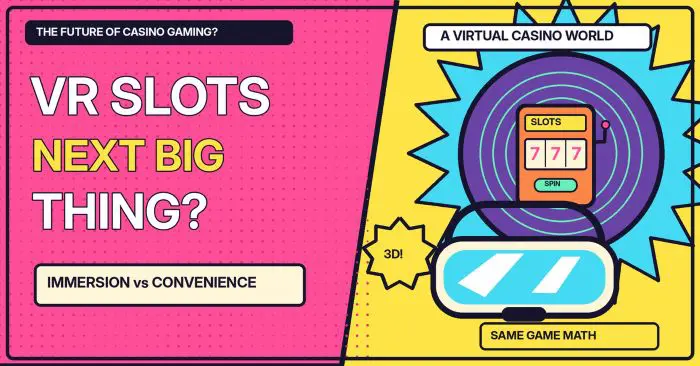
When I used the first headset and walked in front of a virtual slot machine for the first time, I did something a little awkward. I reached out and leaned against the cabinet. My hand passed right through a cabinet that seemed strong enough to hold my drink. I laughed aloud in an empty space. That one moment embodies VR slots. For a couple seconds, the illusion is convincing enough to trick your body into thinking you are physically interacting with the space, then the cracks begin to show.
Are VR slots the next big thing in iGaming?
For more than ten years, people in iGaming have been asking that question, and the answer is interesting – it’s more complicated than either a yes or a no. The technology works. Much of it works extremely well. However, “works” and “dominates the market” are completely different finishing lines. Virtual reality slots have been running towards the second line for many years, and so far have yet to cross it.
What are VR slots?
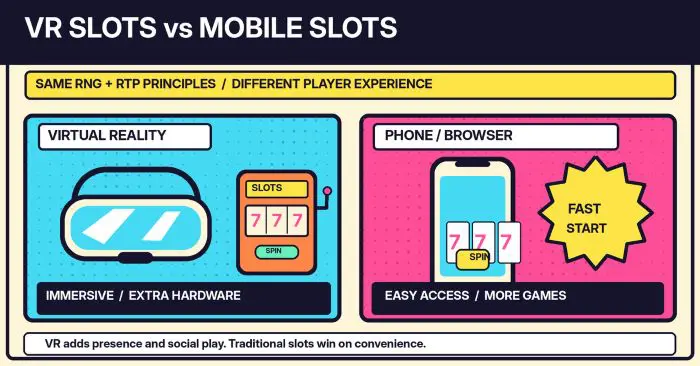
Strip away the marketing hype and VR slot games are just regular slot games that take place in a 3D setting that you view through a headset. Rather than viewing a flat rectangle of reels on your phone, you’re standing in a virtual casino floor, a jungle temple, a neon lounge, etc., depending on what type of space the development team envisioned. The reels may be on a large cabinet directly in front of you, or they may be floating in the air. The entire bonus round may occur about you in 360 degrees. This is the important thing to understand. VR slot machines change how you present yourself, not how the math functions. A slot is still a slot. The random number generator determines the final outcome of each spin. How often the game pays over time is still determined by the game’s return to player (RTP) and volatility. Paylines, wilds, scatters, free spins and multipliers perform their respective duties. Wearing a headset does nothing to change the nature of the RNG. It simply changes the way you lose (or win).
How do VR slot games function underneath?
The basic components will be similar to any VR game. Development teams create the environment within a game engine (usually Unity or Unreal Engine), or for web-based VR experiences, they create the environment using WebGL and WebXR (the successor to WebVR). The 3D assets, light effects, and particle effects all need to render in real-time. In VR, rendering in real-time is more difficult than it appears since the headset must generate two images per eye at a high frame rate. Drop frames and users get dizzy. There is another piece you cannot see. The game logic for the slot, including the RNG and the payout tables typically resides on a remote game server, just like any other online slot. The headset is essentially a very advanced display and input device. When you trigger spin, the request goes to the game server. The game server determines the outcome of your spin. And then, the 3D scene plays out animations that correspond to that outcome. Therefore, having low latency and good wifi connectivity matters more in VR than it does on your phone. While a 1/2 second delay on your phone is frustrating, in VR, delays cause you to perceive the world as non-responsive.
What makes VR slots feel different
Now I’ll give VR credit when it’s due. When VR slots are executed well, immersive slot games are more fun to sit with than flat ones… at least initially. Scale is the largest difference maker. Bonus rounds that burst across your entire field of view can have a physical presence that can’t be matched by a phone screen. In a well-crafted 3D virtual casino environment, big wins don’t just show a number; the room reacts. Lights shift; coins fall past you; music swells from behind. Positional audio does a lot of heavy lifting, surprisingly, in providing a great experience in a VR casino.
Early experiments: almost decades
While many people think VR slots are new, they aren’t that old either. Slots Million, a casino run by Alea, launched one of the first VR casinos back in 2015 using an early version of the Oculus Rift. Players could walk around a skyscraper floor in a virtual world and play real money slot machines inside it. It was clumsy compared to today’s standards; however, it demonstrated the concept.
However, there is one case study that everyone in the industry remembers—NetEnt’s Gonzo’s Quest VR. NetEnt took one of its best-known slots and rebuilt it as a browser-based VR experience using WebVR & real-time 3D. Players were placed inside a Mayan-themed world where they could look around and see the reels floating on air. It received quite a bit of attention during trade shows in 2016 & 2017 — and it was designed for use with real-money bets. Since that time, NetEnt has been acquired by Evolution group and although the company still markets the product internally on their website & through other marketing channels, it never became a mainstream product. Articles have even appeared in trade press asking whether NetEnt has abandoned its plans for VR slots.
Microgaming also had roulette prototypes working in VR around the same time frame. Many small studios produced titles which came & went quickly over the years. The pattern continued: impressive demo; enthusiastic news coverage; then very little follow-up once developers saw who actually bought the Headsets.
On the play-money side of things, though, things were better than expected. PokerStars VR (which later relaunched as Vegas Infinite) built a busy social casino with poker, blackjack, roulette, and slots all using virtual chips. Apps such as Jackpot VR and various “vegas” titles available on the Meta Store are similar examples as well. These types of products are entertaining; social; and free to start playing (using virtual credits); yet are not really about gambling.
What can virtual reality casinos offer players?
If you imagine the ultimate version of a shared virtual gaming floor five years out — it will be easy to understand why they would be so appealing. A shared virtual gaming floor where you meet friends that live hundreds or thousands of miles away from each other. Slot tournaments where you can physically see the leaderboard on the wall and the leaders standing near it. Live dealer games merged with virtual spaces so that a real croupier streams into a 3-d space. Themed slot parlor areas that feel like theme park rides rather than menu options.
Why haven’t VR slots become mainstream?
There are several reasons. Every few years, someone declares that this year will finally be the breakout year for VR gambling. Here are some of them:
Most people don’t buy a headset — especially not for a niche activity like virtual reality slots. Meta raised prices on their latest versions of the Quest headset in April 2026 to $349.99 (Quest 3s) and $599.99 (Quest 3) in the u.s.; Apple also released the Vision Pro for $3,499. While many people own a headset — Headsets remain extremely rare compared to phones — which are used by billions.
Real money slots are forbidden from most app stores — including facebook/meta’s stores — due to their anti-problem gaming policies. Social casino apps with virtual chips are allowed within those platforms — and they fill up those stores — but real money VR slots must typically exist outside those platforms — which adds friction.
Creating one high-quality VR slot costs significantly more than creating a standard HTML5 slot — and companies often ship dozens of regular slots for large audiences before shipping one single high-quality VR slot — which limits growth potential.
Limited comfort creates limited session length — Headsets get hot & heavily weighted — users may experience motion sickness — and overall comfort issues limit sessions short enough that you won’t wear your headset long enough to engage in casual slots sessions — which is exactly what slots are designed for.
Regulations were written without thinking about VR gaming — providers need to demonstrate that responsible tools for problem gaming (such as self-limitations and age verification tools), balance checks, and rule enforcement work equally well inside a headset — which means regulators lack precedent to draw upon.
Virtual reality safety & fairness concerns
This section would be something I’d want any friend to read before trying real-money VR slots. As far as fairness goes — fortunately the answer is very simple: if done correctly, a licensed VR slot uses exactly the same type of certified random number generator as any traditional online slot. Testing laboratories such as eCOGRA, iTech Labs & GLI test the math of both traditional online slots and modern-day VR slots in exactly the same way regardless of presentation style. The RTP of a VR slot should match that of a non-virtual slot if it is based on the same game design — but always check the information screen in the game for your own peace of mind because sometimes providers release different variants of games at different RTP settings.
What would good look like? Session reminders appear directly in your line-of-sight instead of buried deep within a menu you never open. Visible balances & clocks stay locked in your line-of-sight throughout your session. Deposit limits set prior to using the headset — loss limits set prior to using the headset — proper age verification & know your customer processes must be implemented because passing around a family headset is a very different risk factor than passing around a cellphone with face recognition security.
Before you try it, consider doing the following:
Check that any site offering real-money betting via VR is licensed by a regulatory body you recognize (examples include: the UK Gambling Commission — or the Malta Gaming Authority) & review what specific items that license covers in your country — licensing requirements vary widely between countries.
Set deposit & time limits in your account prior to starting — not after you’ve already started.
Use the free play mode or demo mode before investing any real-money — to determine if you enjoy the novelty aspect or if you’re simply enjoying playing slots period.
Remove your headset every 20-30 minutes — both for comfort reasons and to reset your sense of time & spending habits.
If you find yourself feeling uncomfortable with your gambling behavior, organizations such as GamCare, BeGambleAware & Gamblers Anonymous provide free — confidential support.
Will VR slots ever become mainstream?
Honestly? No — but possibly as premium content.
I don’t expect VR slots to replace online slots anytime soon — too convenient to access from your phone — too many choices / titles to choose from — too cautious to allow regulated marketplaces to permit adoption.
What i do expect to happen — eventually — is for vr to function as showcase format — flagship titles — special events — slot tournaments — social nights in virtual lounges — & limited releases based on major brands.
Think of it as running a quiz night @ your local pub rather than having every evening be quiz night.